Cross country is the one place in running where the shoe is decided by the ground rather than by your pace. Grass, mud, a hill you have to climb twice and three to six miles of it: that asks for pins, a light shoe and almost no cushioning. These five are ranked on traction first, then weight, then how much of a season they will survive.
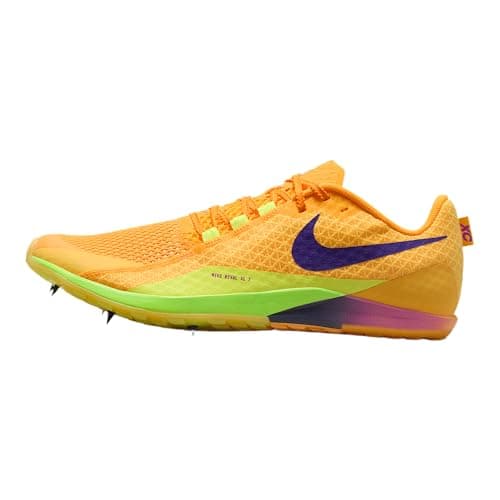
Six removable pins — the most grip here — on a Phylon midsole that survives a season, and Running Warehouse's own pick for beginners. The honest cons: 6.6 oz with spikes in makes it the heaviest shoe on this page, Phylon is nowhere near ZoomX for energy return, and the size run stops at M12.0.
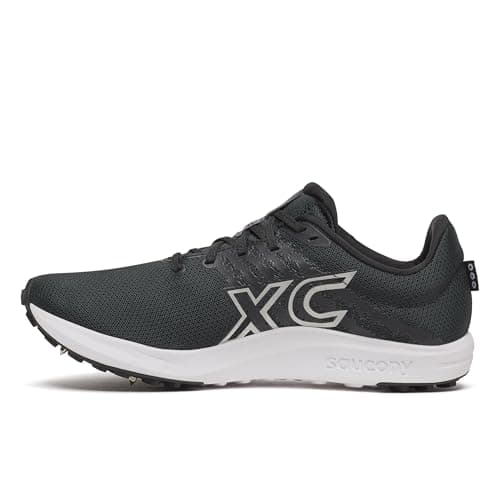
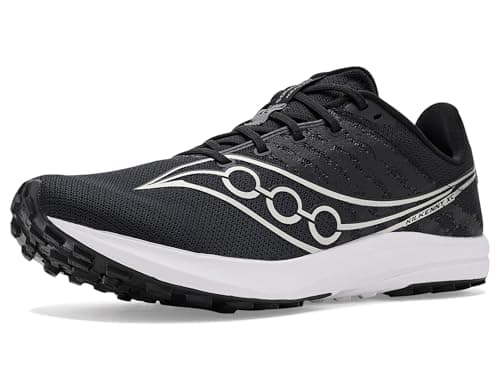
PWRRUN foam, a 4-pin plate and a size run to M14.0, with a matching flat in the same model. The cons: four pins grip a sloppy course less than six, 6.2 oz is not light, and Saucony publishes neither a stack height nor a drop.
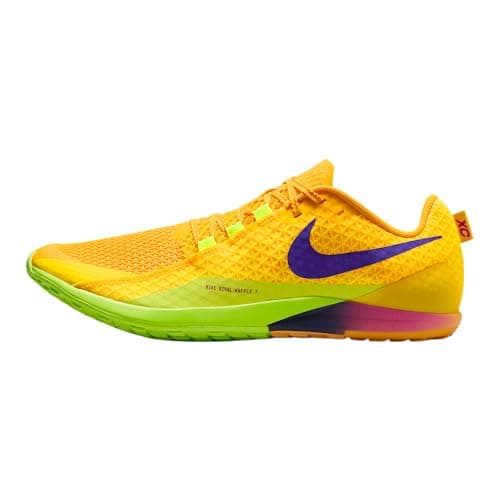
Running Warehouse's best cross-country super spike: ZoomX on a Pebax plate at 5.5 oz, with a second set of mud pyramid pins in the box. The cons are the price — roughly double a first spike — race foam that wears fast, and no Amazon listing at all, so our link goes to the retailer and earns us nothing.
5.4 oz on rubber lugs: the Kilkenny without pins, which makes it the only shoe here that doubles as a workout and warm-up shoe. The cons: Running Warehouse lists only four size options, a flat gives up real grip on wet grass, and there is very little cushioning.
A full-length waffle outsole instead of a plate, so it is legal where pins are not and comfortable on paved sections. The cons: a waffle will not hold a wet grass hill like pins do, 6.4 oz is heavy for a racer, and Phylon is a training foam.
#ad · Prices come live from Amazon, last checked October 12, 2026. Scores are ours, compiled from published specs and the maker's intended use. Some photos are stock. Tap a row for the full write-up.
The short version
Buy the Nike Zoom Rival XC 7. It has six removable pins, which is the most traction on this page, a Phylon midsole with enough substance to last a season of meets, and Running Warehouse names it the best cross-country shoe for beginners in its 2026 guide. For a first spike, nothing here is a better-judged buy.
If your feet are larger than a men's 12 or you want one model in both spiked and spikeless form, the Saucony Kilkenny XC10 Spike runs to M14.0 and has a matching flat. If you are racing for places and the budget is there, the Nike ZoomX Dragonfly XC 2 is the only genuinely propulsive shoe here — 5.5 oz of ZoomX over a Pebax plate. If spikes are banned on your course, the Nike Zoom Rival Waffle 7 is the legal answer, and the Saucony Kilkenny XC10 Flat is the lightest shoe on the page at 5.4 oz.
How we ranked these
Cross-country racers are judged on different things from road shoes, so the order of the criteria changes. We scored every shoe on the site's shoe rubric — level fit (30), mileage protection (25), stability and fit range (15), pace responsiveness (15) and rotation versatility (15), published on how we pick — and for this page the reasoning behind those scores ran in this order:
Traction, before anything else. A cross-country course is grass, dirt and mud with at least one hill. If the shoe slips, nothing else about it matters. Pin count and outsole pattern decide this, and they are the first thing in every entry below.
Weight, measured as published. These are racing shoes used over 3K to 10K. Every figure on this page is Running Warehouse's published weight for a single shoe, with spikes fitted where they are fitted, so the numbers are comparable to each other rather than to a marketing claim.
Enough shoe to survive the season. A Phylon or PWRRUN midsole takes more abuse than a race foam. This is where the cheap spikes score better than the expensive one, and we say so.
Whether the size you need exists. Cross-country shoes are sold in unisex size runs that are much shorter than a road shoe's. Two of the five here stop well before a men's 13, and that is a disqualifier rather than a footnote.
Published specs only. This site does not lab-test shoes. Every weight, pin count, foam and surface claim below links to the product page that published it, and where a brand publishes no stack height or drop — Saucony does not, for either Kilkenny — the entry says so rather than guessing.
On price: the three entry models here sit in one bracket, and the super spike sits at roughly double it, per the list prices on the retailer pages linked throughout. We do not print a number in the text, because the figure on each buy button is the live one.
Spikes, flats or spikeless?
This is the real decision, and it is made by your course and your meet rather than by preference. The three categories are:
Type
What it is
Buy it when
Spike
A plate under the forefoot that takes screw-in metal pins
Grass, mud and hills, and your meet allows pins. Best grip available, almost no cushioning, useless on pavement
Flat
A lightweight racer on a lugged rubber outsole
Firm, dry or mixed courses; workouts and warm-ups. Lighter than most spikes and usable on roads
Spikeless XC
A waffle or lugged outsole on a spike-style upper
Meets that ban pins, courses with paved sections, and younger runners in their first season
Pin length and whether pins are allowed at all are set by the meet and by the governing body it runs under, and they vary from course to course — a frozen or paved section often means pins are restricted. Read the meet information or ask the coach before race day rather than assuming, because arriving with the wrong shoe is a problem you cannot fix in the chute. That is the practical argument for owning a flat as well as a spike, and it is why both Kilkenny versions are on this page.
Pin count is the traction spec
Pins do the gripping, and the plate decides how many you get. The spread here is wider than most people expect:
Shoe
Pins
What that buys
Nike Zoom Rival XC 7
6, removable
The most bite here; the shoe for a sloppy course
Saucony Kilkenny XC10 Spike
4, removable
Enough for grass and firm dirt; less in deep mud
Nike ZoomX Dragonfly XC 2
5, plus a second set of mud pyramid pins
Two pin shapes for two course conditions
Saucony Kilkenny XC10 Flat
None — rubber lugs
Grip on firm ground, nothing on wet grass
Nike Zoom Rival Waffle 7
None — full-length waffle
Spike-free legality and paved-section comfort
Two details matter more than the count. The first is that pins are consumable: they bend, they round off and they fall out, and both Nike spikes and the Kilkenny ship with a wrench for exactly that reason. Check them the night before a meet, not at the start line. The second is that the Dragonfly XC 2 includes two complete sets — a standard needle and a deeper, broader mud pyramid — which is a genuine advantage on a course that changes with the weather, and one reason it costs what it does.
Weight, and why cushioning is missing
Published single-shoe weights here run from 5.4 oz to 6.6 oz. That is 1.2 oz of spread, which sounds trivial and is not: at the top of a hill in the fourth mile it is the difference you feel first.
Saucony Kilkenny XC10 Flat — 5.4 oz. The lightest shoe on the page, and the only one with no pins to add.
Nike ZoomX Dragonfly XC 2 — 5.5 oz with spikes fitted. That is the number that justifies the super-spike label: it is lighter with pins than most flats are without.
Saucony Kilkenny XC10 Spike — 6.2 oz. Mid-pack, with more foam than the Dragonfly.
Nike Zoom Rival Waffle 7 — 6.4 oz. Heavy for a racer, but it is the spikeless one.
Nike Zoom Rival XC 7 — 6.6 oz with spikes fitted. The heaviest here, and the most protective.
The missing cushioning is deliberate, not a cost saving. A cross-country shoe is built to transmit the ground rather than absorb it, which is what lets you push off wet grass. The consequence is that a 5.5 oz spike gives your legs nothing on the way back down a hill, and that is why nobody trains in them. If you want to know what a stack height and a drop are doing in a shoe you do train in, our heel drop and stack height explained guide covers it.
Published specs from each shoe's Running Warehouse product page; every value links to its source. Neither brand publishes a stack height or drop for these models, so those rows are not shown.
Fit and sizing a racer
Cross-country shoes are sold in unisex sizing, which means a women's 9 and a men's 7.5 are the same shoe, and it means the available range is narrower than a road shoe's. Check this before you fall in love with a model: the Rival XC 7 stops at M12.0, the Kilkenny Flat is listed in only four size options, and the Waffle 7 starts smallest of all at M4.5/W6.0, which is why it is the common first-season shoe for younger runners.
On fit itself, a racer is meant to be snug — a spike that moves on your foot wastes the pins — but “snug” is not “short.” The American Academy of Orthopaedic Surgeons advice on athletic shoes still applies: leave room at the end of the longest toe and fit the shoe to the larger foot. Our what size running shoes should I get page has the full method, and it is worth reading before ordering a unisex shoe online.
One more practical note: these are thin-walled shoes and the upper on three of the five is open or engineered mesh that drains deliberately. Expect wet feet on a wet course, and race in a sock that handles it — our best running socks page covers the ones that do.
What to train in instead
A cross-country season is maybe eight to twelve races and a lot of training, and the training is where the shoes get used. The sensible kit is:
A daily trainer for everything easy. This takes 80% or more of the miles and it is the most important shoe you own — see best daily trainer running shoes.
A flat or a light trainer for grass strides, hill repeats and warm-ups. The Kilkenny XC10 Flat does this job; so does a lighter road shoe from our best tempo running shoes page.
A spike for races, and for one or two sharpening sessions on grass so race day is not the first time you have worn them.
A trail shoe if your training routes are genuinely off-road rather than grass — a different category with different lugs, covered on best trail running shoes.
If that sounds like a lot of shoes, it is the same logic as any rotation: different jobs, different shoes, and the race pair lasts longer because it is not doing the training. Our rotation guide works through what to buy first.
How long a pair lasts
Measured in miles, a spike barely gets used: a 5K race is three miles, so a full season of racing might be under 40 miles of wear. Measured in abuse, it is harder than that sounds — mud, grit and wet grass are rougher on an upper than clean pavement, and the pins stress the plate every stride.
In practice a well-cared-for spike lasts multiple seasons and outgrowing it is the usual reason to replace it. The maintenance that actually matters: rinse the mud off rather than letting it dry in the mesh, pull the pins out after a wet meet so they do not seize in the plate, and let the shoe dry away from direct heat. Our when to replace running shoes page covers the wear signs for the trainers doing the real mileage.
Where to buy, and what it should cost
Worth knowing before you click: Nike's cross-country shoes on Amazon are listed by third-party sellers rather than by Nike, and on the day we checked both Nike listings here were priced above the retailer list price on Running Warehouse. The live price on each buy button is the real one, so compare it against the retailer page we link in the sources before you buy — if the Amazon listing is marked up, buy it from a running retailer instead. We would rather say that than send you at a bad listing.
The Dragonfly XC 2 has no Amazon listing we could verify at all, so its button is a plain link to Running Warehouse that earns us nothing. That is the honest state of this category: spikes are a specialist product and the specialist retailers carry them properly.
In detail
The picks, in full
1
Best cross-country spike
Nike Zoom Rival XC 7
C25K10KHALFMARATHON
6.5 /10
Six removable pins — the most grip here — on a Phylon midsole that survives a season, and Running Warehouse's own pick for beginners. The honest cons: 6.6 oz with spikes in makes it the heaviest shoe on this page, Phylon is nowhere near ZoomX for energy return, and the size run stops at M12.0.
#ad · Price as of October 12, 2026 · Sold on Amazon through third-party sellers · Affiliate disclosure for the link to Nike Zoom Rival XC 7
2
Best for a full season of meets
Saucony Kilkenny XC10 Spike
C25K10KHALFMARATHON
6.6 /10
PWRRUN foam, a 4-pin plate and a size run to M14.0, with a matching flat in the same model. The cons: four pins grip a sloppy course less than six, 6.2 oz is not light, and Saucony publishes neither a stack height nor a drop.
#ad · Price as of October 12, 2026 · Affiliate disclosure for the link to Saucony Kilkenny XC10 Spike
3
Stock photo
Best super spike, if you are racing for places
Nike ZoomX Dragonfly XC 2
C25K10KHALFMARATHON
6.3 /10
Running Warehouse's best cross-country super spike: ZoomX on a Pebax plate at 5.5 oz, with a second set of mud pyramid pins in the box. The cons are the price — roughly double a first spike — race foam that wears fast, and no Amazon listing at all, so our link goes to the retailer and earns us nothing.
Not sold on Amazon. Plain link — we don't earn a commission there.
4
Lightest, and the one you can train in
Saucony Kilkenny XC10 Flat
C25K10KHALFMARATHON
6.8 /10
5.4 oz on rubber lugs: the Kilkenny without pins, which makes it the only shoe here that doubles as a workout and warm-up shoe. The cons: Running Warehouse lists only four size options, a flat gives up real grip on wet grass, and there is very little cushioning.
#ad · Price as of October 12, 2026 · Affiliate disclosure for the link to Saucony Kilkenny XC10 Flat
5
Best spikeless, for courses that ban pins
Nike Zoom Rival Waffle 7
C25K10KHALFMARATHON
6.8 /10
A full-length waffle outsole instead of a plate, so it is legal where pins are not and comfortable on paved sections. The cons: a waffle will not hold a wet grass hill like pins do, 6.4 oz is heavy for a racer, and Phylon is a training foam.
#ad · Price as of October 12, 2026 · Sold on Amazon through third-party sellers · Affiliate disclosure for the link to Nike Zoom Rival Waffle 7
Common mistakes
Buying a spike as your only running shoe. It has almost no cushioning and it is illegal on most surfaces you train on. Buy the trainer first, always.
Buying the super spike for a first season. The Dragonfly XC 2 is the fastest shoe here and roughly twice the price of the Rival XC 7. A first-year runner gets more from six pins and a Phylon midsole than from ZoomX.
Ignoring the pin rules for your meet. Allowed pin length varies by meet and by surface, and a course with paved sections may ban them outright. Check the meet information, not a forum.
Racing in brand-new spikes. Wear them for one or two sets of grass strides first. A shoe with no cushioning in a position your foot has never been in is how a calf goes.
Sizing a unisex shoe like a men's shoe. M7.5/W9.0 is one shoe with two labels. Read the conversion on the listing and fit the larger foot.
Leaving wet pins in the plate. They seize. Thirty seconds with the wrench after a muddy meet is the whole of spike maintenance.
How we chose these
Researched, compared, scored for your level
We start from what a published training plan actually asks of a runner at your level, compare every model's published specs (stack height, drop, weight, plate, stability features, widths) against that job, and score each pick on a public rubric. Each spec links to where it came from, so you can shortlist in minutes and buy with the numbers in front of you.
The Nike Zoom Rival XC 7 for most runners: six removable pins, a durable Phylon midsole and the lowest entry price of the spikes here, and it is Running Warehouse's own pick for beginners. If you are racing for places, the Nike ZoomX Dragonfly XC 2 is the faster shoe — 5.5 oz of ZoomX over a Pebax plate — at roughly twice the price.
Do I need spikes for cross country?+
Not always. Spikes grip grass, dirt and mud better than anything else, but some meets restrict or ban pins and some courses include paved sections where they are a liability. A spikeless racer like the Nike Zoom Rival Waffle 7 or a flat like the Saucony Kilkenny XC10 Flat covers those races, and plenty of first-season runners race the whole year in a flat.
What is the difference between a cross-country spike and a flat?+
A spike has a plate under the forefoot that takes screw-in metal pins; a flat has a lugged rubber outsole and no pins. The spike grips soft ground better and is useless on pavement. The flat is usually lighter — the Kilkenny XC10 Flat is 5.4 oz against 6.2 oz for the spike version — and it can be used for workouts and warm-ups, which no spike can.
Can you train in cross-country spikes?+
No, beyond the odd set of grass strides to get used to them. Spikes have almost no cushioning and the pins make them unusable on roads and tracks you are not racing on. Train in a daily trainer and keep the spikes for meets — our best daily trainer running shoes page is the place to start.
How many spikes should a cross-country shoe have?+
Four to six pins is the normal range, and more pins means more bite on soft ground. The Nike Zoom Rival XC 7 takes six, the Nike ZoomX Dragonfly XC 2 takes five (with a second set of deeper mud pyramid pins in the box) and the Saucony Kilkenny XC10 Spike takes four. Allowed pin length is set by your meet, so check its information before race day.
Are cross-country shoes unisex?+
Mostly, yes. All five shoes here are sold in unisex size runs — M7.5/W9.0 means one shoe with two labels — and the ranges are shorter than a road shoe's. The Rival XC 7 stops at M12.0 and the Waffle 7 starts at M4.5/W6.0, so check the size run before you settle on a model.
How long do cross-country spikes last?+
Several seasons for most runners, because the mileage is tiny: a 5K race is three miles, so a full season of racing may be under 40 miles of wear. Mud and grit age the upper faster than the miles do, so rinse them after wet meets, remove the pins so they do not seize, and dry them away from direct heat.
Every figure above is traceable. Specs come from the maker's own pages or the named reviewer's published measurements (linked above); level definitions come from published training plans; prices come from Amazon's own API and carry the date they were checked, so you buy on a current number. Read the full method.