Shoes · Guide
Running Shoes vs Hiking Shoes: Which One for Which Day Out
A trail running shoe and a hiking shoe solve the same terrain with opposite priorities: one is light and flexible, the other stiff and protective. This guide sets out the four differences that matter, and the pack weight at which the answer flips.
We earn a commission if you buy through our links, at no extra cost to you. It never decides the ranking — the method is published · Affiliate disclosure
Two shoes, one terrain, opposite priorities
Both categories are built for the same ground, which is why the question comes up. They disagree about what to optimize. A trail running shoe minimizes weight so you can move fast and takes its protection from a thick midsole. A hiking shoe accepts weight in exchange for stiffness and structure so it can carry a load over uneven ground for hours. On's own comparison of the two categories puts it as "lightweight and flexible" against "heavier and more supportive", with hiking shoes using "stiff midsoles, often reinforced with nylon or TPU shanks" and denser foams.
The four differences that matter
- Sole stiffness, measured as torsional rigidity. This is the one that decides most cases. A stiff platform resists twisting on rock and under load; a flexible one lets your foot work naturally and roll through a stride. Trail running shoes span the range: RunRepeat scores the New Balance Hierro v9 at 5/5 — the stiffest rating it gives, and genuinely hiking-shoe territory — while lighter trail shoes sit far below that.
- Lug depth and outsole. Here the two categories overlap almost completely. RunRepeat's trail guide treats lugs above roughly 4 mm as deep-lug, technical-terrain rubber, and the HOKA Speedgoat 7 measures 4.5 mm on Vibram Megagrip — the same outsole compound a lot of hiking footwear uses.
- Weight. The three trail shoes we rank weigh 9.9–10.9 oz per shoe in RunRepeat's lab. Hiking boots commonly weigh considerably more, and the cost compounds over thousands of steps.
- Underfoot protection. Hiking shoes use denser midsoles and more substantial outsoles; trail runners use a thick, softer midsole with a thinner outsole. Both work, but thinner outsoles transmit more sharp rock, which is the complaint most often made about running shoes on stony ground.
What about ordinary road running shoes?
Different question, simpler answer. A road running shoe has a smooth or lightly patterned outsole and a soft, unprotected midsole, so on a hike it gives you no grip on wet or loose ground and nothing between you and rock. It is fine on gravel paths, canal towpaths and dry fire roads — exactly the surfaces where you also do not need a trail shoe. The AAOS advice to match the shoe to the demands of the activity applies directly, and Harvard Health makes the same point about running and walking shoes being built around different motions. If you are deciding between road and trail rather than running and hiking, our running shoes vs trail running shoes comparison covers it.
The ankle support argument, honestly
The standard case for a boot is that the high collar protects your ankle. The honest position is that this is contested rather than settled, and that the platform under your foot matters more than the fabric above it: a torsionally stiff sole keeps the shoe from twisting in the first place, which is why RunRepeat measures and publishes that figure. A heel counter does measurable work too — the adidas Terrex Agravic 4 scores 4/5 for heel counter stiffness against the Speedgoat 7's 3/5. What no low-cut shoe does, trail runner or otherwise, is immobilise an ankle. If you have a history of bad sprains and you are carrying a pack over rough ground, that is the case where a boot is the sensible choice.
Three trail shoes that double as hiking shoes
If your hiking is day walks on trails rather than expeditions, these three are the ones we rank — and each covers a different part of the overlap. All lab figures on the cards are RunRepeat's.
Picks for this job
Three trail shoes for running and walking the same ground
Chosen on measured lug depth, outsole durability and torsional rigidity rather than on brand.
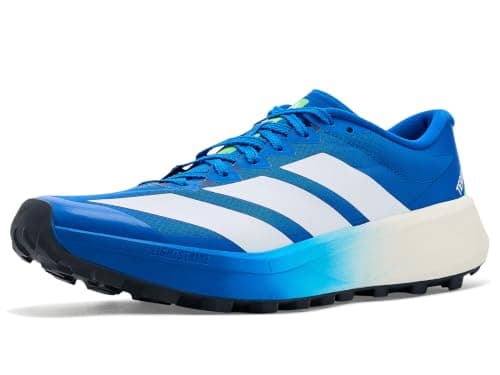
A first trail shoe, and gravel
adidas Terrex Agravic 4
The best all-rounder for mixed ground: 3.1 mm lugs on a full-length Continental outsole, a 4/5 heel counter and the strongest Dremel durability result of the three at 0.5 mm removed. Normal width only.
$134.65Amazon#ad · Price as of October 11, 2026 · Affiliate disclosure for the link to adidas Terrex Agravic 4
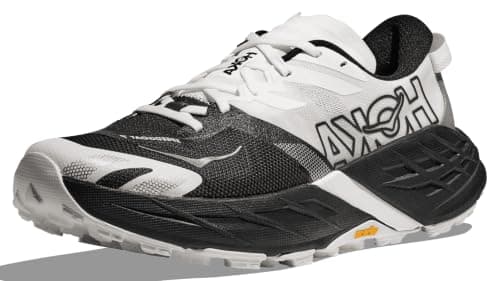
Technical trails and long days off road
HOKA Speedgoat 7
The pick when the ground is steep, loose or wet: 4.5 mm lugs on Vibram Megagrip, and an outsole durability result RunRepeat calls exceptional. Narrow, Normal and Wide.
Check price · Amazon#ad · Price as of October 11, 2026 · Sold on Amazon through third-party sellers · Affiliate disclosure for the link to HOKA Speedgoat 7
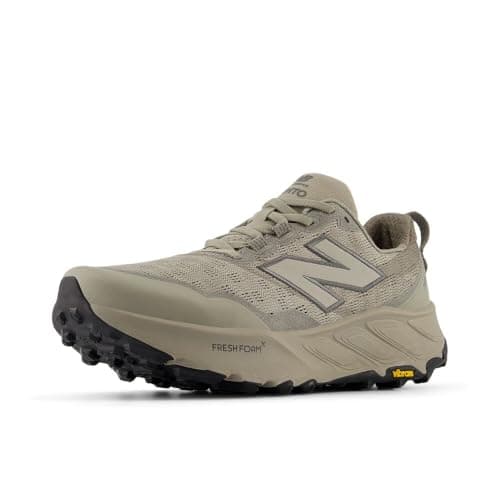
Long trail runs and wide feet
New Balance Fresh Foam X Hierro v9
The closest thing here to a hiking shoe: 37.3 mm of measured heel foam and a 5/5 torsional rigidity score, the stiffest RunRepeat awards, in four widths to X-Wide.
$159.95Amazon#ad · Price as of October 11, 2026 · Affiliate disclosure for the link to New Balance Fresh Foam X Hierro v9
The full ranking, with the lug-depth and durability tables, is best trail running shoes.
A decision table
| What you are doing | Buy this | Why |
|---|---|---|
| Day hike on a runnable trail, light pack | Trail running shoe | Lighter, better cushioned, grip is equivalent |
| Gravel path, towpath, dry fire road | Your road running shoes | No grip or protection problem to solve |
| Long day, rocky ground, moderate pack | A stiff trail shoe like the Hierro v9 | 5/5 torsional rigidity and 37.3 mm of foam |
| Multi-day trek with a heavy pack | Hiking boot | Stiff shank, denser midsole, built for load |
| Scrambling, or a history of bad ankle sprains with a pack | Hiking boot | Structure above and below the ankle |
| Trail running, any distance | Trail running shoe | A stiff boot fights a running stride on every step |
Fit changes when you are walking downhill
One practical warning. Walking downhill for hours pushes your foot forward into the front of the shoe repeatedly, and feet swell over a long day. The AAOS half-inch of toe room and Running Warehouse's thumb's-width rule are minimums here, not targets. Many people go a half size larger for long days off road than for road running, and a heel-lock lacing pattern through the top eyelet is worth learning — our narrow-feet guide explains how to tie it. If your toes have been black after a hike, that is a sizing problem, not a shoe-category problem. See also what size running shoes to get.
How we chose these
Researched, compared, scored for your level
We start from what a published training plan actually asks of a runner at your level, compare every model's published specs (stack height, drop, weight, plate, stability features, widths) against that job, and score each pick on a public rubric. Each spec links to where it came from, so you can shortlist in minutes and buy with the numbers in front of you.
Scores are our editorial judgments from that documented research, and rankings are earned on the rubric alone — placement is never for sale. The rubric and weights are on the How We Pick page.
Questions
Frequently asked
Can I use trail running shoes for hiking?
What is the difference between running shoes and hiking shoes?
Can I hike in normal road running shoes?
Do hiking boots prevent ankle sprains?
Which trail running shoe is closest to a hiking shoe?
Keep going
Related reading
Receipts
Sources
- On — Trail running shoes vs hiking shoes: sole stiffness, weight, midsole density and lugs (checked 2026-10-11)
- RunRepeat — HOKA Speedgoat 7 lab review: 4.5 mm lugs, Dremel durability, heel counter 3/5 (checked 2026-10-11)
- RunRepeat — adidas Terrex Agravic 4 lab review: 3.1 mm lugs, heel counter 4/5, 0.5 mm Dremel (checked 2026-10-11)
- RunRepeat — New Balance Fresh Foam X Hierro v9 lab review: 5/5 torsional rigidity, four widths (checked 2026-10-11)
- RunRepeat — Best trail running shoes guide: lug-depth bands (checked 2026-10-11)
- OrthoInfo (AAOS) — Athletic Shoes: matching the shoe to the activity, toe room (checked 2026-10-11)
- Harvard Health — The right shoe for walking and running (checked 2026-10-11)
- Running Warehouse — Shoe Fit Tips (checked 2026-10-11)
Every figure above is traceable. Specs come from the maker's own pages or the named reviewer's published measurements (linked above); level definitions come from published training plans; prices come from Amazon's own API and carry the date they were checked, so you buy on a current number. Read the full method.