Running Gear · Guide
How to Carry Water While Running, From Your First 5K to Marathon Long Runs
Short runs don't need water on board. Long runs do, and how much depends on you, not a chart. Here's how to work out your own number, the four ways to carry it, and what fits each level.
We earn a commission if you buy through our links, at no extra cost to you. It never decides the ranking — the method is published · Affiliate disclosure
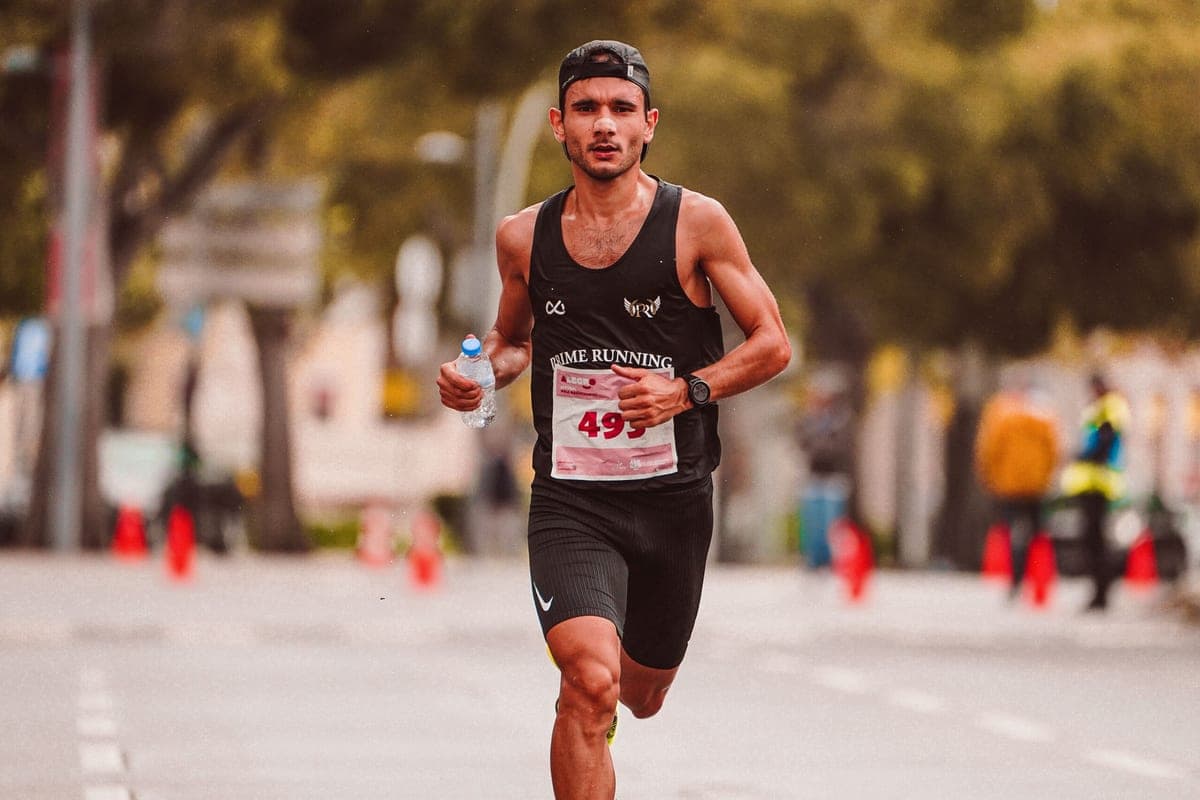
How you carry water while running depends on how far you're going. For Couch-to-5K and most 10K training you don't need to carry any: drink before and after. For half-marathon long runs, a handheld bottle or a belt with flasks does the job. For marathon long runs, use a belt and plan refills, or wear a vest. How much to carry isn't a number anyone can hand you. The American College of Sports Medicine and the National Athletic Trainers' Association both recommend individual plans based on your own sweat rate, and both warn against drinking more than you lose.
Do you need to carry water? Level by level
| Level | Longest run in the plan | Carry water? |
|---|---|---|
| C25K | 30 minutes of running by week 9 (NHS Couch to 5K) | No. The NHS kit advice covers clothes, shoes, a sports bra and a phone armband, not water |
| 10K | 5.5-mile weekend run, then the 10K (Higdon Novice 10K) | Usually not; a small handheld on hot days if you want one |
| HALF | Long run builds to 10 miles (Higdon Novice 1 Half) | On long runs: a handheld or a belt |
| MARATHON | Long run peaks at 20 miles (Higdon Novice 1 Marathon) | On long runs: a belt with planned refills, or a vest |
For shorter runs, NATA's position statement on fluid replacement is reassuring: "Most individuals can avoid fluid-balance problems by drinking when thirsty during and after exercise and eating a healthy diet." Carrying water starts to matter when runs get long enough that you'll be thirsty before you're home.
How much water should you carry on a long run?
The honest answer is: it depends on your sweat rate, and the published guidance says so plainly. We won't give you a milliliters-per-hour figure, because neither position statement below does.
- The ACSM's position stand on exercise and fluid replacement says the goal of drinking during exercise is to prevent excessive dehydration (more than 2% body weight loss from water deficit) and excessive changes in electrolyte balance. Because sweat rates vary considerably between individuals, it recommends customized fluid replacement programs, and notes that you can estimate your sweat rate by weighing yourself before and after exercise.
- NATA puts adult sweat rates during exercise anywhere from 0.5 to 4.0 liters an hour. Its recommendations: aim to finish with a body mass loss of less than 2%, and don't gain weight over a session. Drinking more than you lose, including sports drinks, can cause exercise-associated hyponatremia (dangerously low blood sodium), particularly in exercise lasting an hour or more.
NATA's own example shows why a single number fails: a first-time marathoner with a 0.4 L/h sweat rate aiming to finish in six hours "should not receive the same hydration plan" as an elite runner sweating more than 2 L/h and aiming for 2.25 hours.
Find your number: the sweat-rate test
NATA's statement gives a simple equation. Use kilograms and liters, and the answer comes out in liters per hour.
- Weigh yourself right before a typical run, in the kit you run in.
- Run as you normally would, in the conditions you usually train in. An hour is a practical test length.
- Keep track of anything you drink during the run, in liters, and any urine, if you stop.
- Towel off and weigh yourself again straight after.
- Sweat loss (L) = weight before (kg) minus weight after (kg), plus fluid drunk (L), minus urine (L).
- Sweat rate (L/h) = sweat loss divided by the hours you ran.
NATA recommends repeating the test several times, in realistic conditions and at different intensities, because sweat rate changes with environment, intensity, body size and acclimatization. A summer number and a winter number can differ.
Then turn it into a carry plan. The target NATA sets is a range: finish having lost less than 2% of your body mass, and never heavier than you started. For a runner who weighs 70 kg, 2% is 1.4 kg, by our arithmetic. Work out how much you'd need to drink on your longest run to stay inside that range, subtract what you can pick up from fountains or aid stations along the way, and what's left is what to carry.
The four ways to carry water
1. A handheld bottle
The least gear. A strap holds the bottle to your hand, so you don't have to grip it. Capacities in our picks run from 12 oz (Nathan QuickSqueeze Lite) through 14 oz (Nathan ExoShot 2.0) and 18 oz (Nathan SpeedDraw 2) to 20 oz (Amphipod Hydraform Jett-Lite). Good for 10K runs and half-marathon training; one bottle runs short on marathon long runs unless you can refill.
2. A belt
Hands free, with the weight at your hips. The Salomon Pulse holds two 500 ml flasks, about a liter; the Nathan Peak carries one 18 oz flask in an angled holder. A liter is the most any belt we cover carries. Our best running belts ranks the options.
3. A vest
The most capacity. Flask vests carry two soft flasks up front (500 ml each in the Salomon ADV Skin 5, 20 oz each in the Nathan Pinnacle); bladder vests carry more on your back (the Nathan VaporAir ships with a 2-liter reservoir). Our best hydration vests covers seven.
4. Don't carry it: plan the route
The lightest way to carry water is not to. Loop your long run past your front door or car, where a bottle is waiting, or through a park with fountains. It takes planning, but it means you carry nothing, and it works at every level.
If you're weighing the middle two, our hydration vest vs belt comparison goes through the trade-offs for half and marathon runners.
Soft flask or hard bottle?
Whichever carrier you choose, the container matters too. Soft flasks collapse as you drink, pack flat when empty and weigh very little: HydraPak lists its 500 ml UltraFlask Speed at 1.4 oz. The catch is fit. iRunFar's water bottle guide found the 500 ml size "a bit narrow for many running vests," though HydraPak says it fits most pack and larger vest pockets. Hard bottles don't collapse, but they hold their shape in a hand strap or belt holster and can be insulated: the Nathan SpeedDraw 2's double wall is one example, and iRunFar notes the Amphipod Jett-Lite's bottles are dishwasher-safe, which helps if you run with drink mix. For vests, soft flasks; for handhelds and bottle belts, either works.
What to look for
- Capacity that matches your number. Once you know your sweat rate and your long-run length, pick the smallest setup that covers the gap between refills.
- Easy refills. Wide openings (42 mm on the HydraPak UltraFlask Speed and Salomon's flasks) take ice and drink mix, and a flip-open cap refills without unscrewing.
- Somewhere for the phone. The SpeedDraw 2's mesh pocket fits most smartphones, the Peak's zip pocket fits most large-format phones, and the Pinnacle has two water-resistant chest pockets for one.
- Insulation for hot runs. The SpeedDraw 2 is double-wall insulated, and the Peak's flask holder is insulated.
- Race rules. If you'll carry it on race day, check what your race allows (more below).
Picks for this job
Our picks for carrying water
One of each: a handheld for 10K and half training, a bottle belt, a race-day vest for half and full marathons, and the spare flask that fits most vests.
 Stock photo
10K to marathon: the handheld that holds a phone
Nathan SpeedDraw 2 Insulated 18 oz
An 18 oz insulated handheld with a phone pocket and a thumb-hole strap: the simplest way to carry water on half-marathon long runs.
Check price · Amazon#ad · Price set by Amazon · Affiliate disclosure for the link to Nathan SpeedDraw 2 Insulated 18 oz
 Stock photo
Half and marathon: water without a vest
Nathan Peak Hydration Waist Pack
One 18 oz flask in an angled, insulated holder plus a zip phone pocket, for runners who want water without a vest. iRunFar's Best Hydration Waist Pack.
Check price · Amazon#ad · Price set by Amazon · Affiliate disclosure for the link to Nathan Peak Hydration Waist Pack
 Stock photo
Race-day vest for half and full marathons
Nathan Pinnacle 4 Liter Race Vest
Two 20 oz flasks carried up front and two water-resistant phone pockets: a vest built for race day, and the front-carry setup races like Chicago allow.
Check price · Amazon#ad · Price set by Amazon · Affiliate disclosure for the link to Nathan Pinnacle 4 Liter Race Vest
- Stock photo
Spare flask for any vest
HydraPak UltraFlask Speed 500 ml
A 500 ml soft flask with a flip-open SpeedFill cap, 1.4 oz empty: a spare for vest pockets, or a strap-free carry on a short run.
Check price · Amazon#ad · Price set by Amazon · Affiliate disclosure for the link to HydraPak UltraFlask Speed 500 ml
Water or sports drink?
The ACSM's position stand says that during exercise, drinks containing electrolytes and carbohydrates "can provide benefits over water alone under certain circumstances." It doesn't say always. NATA adds two cautions: sports drinks don't protect you from overdrinking, since its hyponatremia warning covers "hypotonic fluids (including sports drinks)", and it found little evidence supporting sodium tablets for retaining fluid. It recommends that sodium supplementation be individualized and practiced before you rely on it. If you plan to use a sports drink or electrolytes in a race, try them on long runs first.
Water on race day
If your race has aid stations, that changes what you need to carry. Hal Higdon's marathon plan notes that it's easier to drink while walking than running, and suggests walking through aid stations. Check the course map: if the stations are frequent, you may carry less than on training long runs, or nothing at all.
If you do carry, check the rules. The Chicago Marathon's rules and safety page bans hydration backpacks and vests with bladders, and says "running vests with front pocket carry, fuel belts, handheld water bottles and soft flasks are allowed." Other races set their own rules. Our marathon race week checklist covers the rest of the race-day plan.
Common mistakes
- Drinking because you're carrying it. A full vest doesn't mean you should empty it. NATA's guidance is not to gain weight over a run.
- Testing only in cool weather. Sweat rate changes with conditions; a spring test can underestimate a summer long run.
- Buying marathon capacity for a 10K. Carrying a vest on a 5-mile run is extra weight with no job to do.
- Trying new kit or drinks on race day. Wear the belt or vest and use the drink on long runs first.
As your long run grows, so does the question. Our half marathon training mileage guide shows how the weeks build, and when water on the run becomes part of the plan.
How we chose these
Shoes we claim to have lab-tested: 0
Plenty of sites say they ran hundreds of miles in every shoe. We didn't, and we say so. What we do instead: start from what a published training plan actually asks of a runner at your level, compare each model's published specs (stack height, drop, weight, plate, stability features, widths) against that job, and score every pick on a public rubric. Each spec links to where it came from.
Scores are editorial judgments from that documented research, not lab results. Nobody pays for placement and we don't accept free products. The rubric and weights are on the How We Pick page.
Questions
Frequently asked
How do you carry water on long runs?
How much water should I carry for a marathon?
Do I need to carry water for a 5K or 10K?
How do you run with a water bottle?
Can you drink too much water while running?
Should I drink water or a sports drink on long runs?
Keep going
Related reading
- Hydration vest vs beltWhich one to carry for a half or full marathon.
- Best hydration vest for runningSeven vests ranked for half and marathon training.
- Best running beltPhone, gel and flask belts for every level.
- Half marathon gear checklistWhere water joins the kit list.
- Marathon race week checklistSettle your race-day water plan before the start.
Receipts
Sources
- NHS — Get running with Couch to 5K
- Hal Higdon — Novice 10K training program
- Hal Higdon — Novice 1 Half Marathon training program
- Hal Higdon — Novice 1 Marathon training program
- American College of Sports Medicine; Sawka MN, et al. American College of Sports Medicine position stand. Exercise and fluid replacement. Medicine and Science in Sports and Exercise, 2007 (PMID 17277604)
- McDermott BP, et al. National Athletic Trainers' Association Position Statement: Fluid Replacement for the Physically Active. Journal of Athletic Training, 2017;52(9):877-895
- Bank of America Chicago Marathon — Rules & Safety
- iRunFar — Best Running Water Bottles of 2026 (published January 29, 2026)
We don't lab-test shoes or gear and we don't pretend to. Specs come from the maker's own pages or the named reviewer's published measurements (linked above); level definitions come from published training plans. Prices are set by Amazon and change often, so we don't print them. Where a figure isn't published, we say so. Read the full method.