Garmin Forerunner 570 vs 970: What the Extra Money Actually Buys
Both watches list training readiness, lactate threshold, running power, PacePro, multi-band GPS and music. Neither is the stripped one. The gap is maps, four long-distance metrics, a flashlight, 8 more hours of GPS battery and 14 more grams on your wrist. Every figure here comes from Garmin's own spec tables.
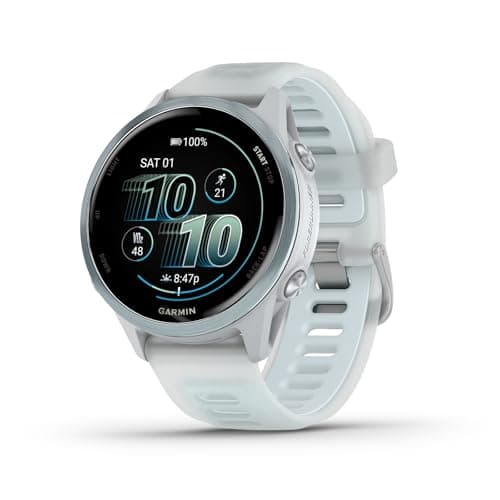
Every core running feature the 970 has, in a 42 mm case Garmin fits to wrists from 115 mm, at 42 g. The cons: no maps on its spec sheet, up to 18 hours of GPS-only battery (the shortest premium Garmin here), and no endurance score, hill score or running tolerance.
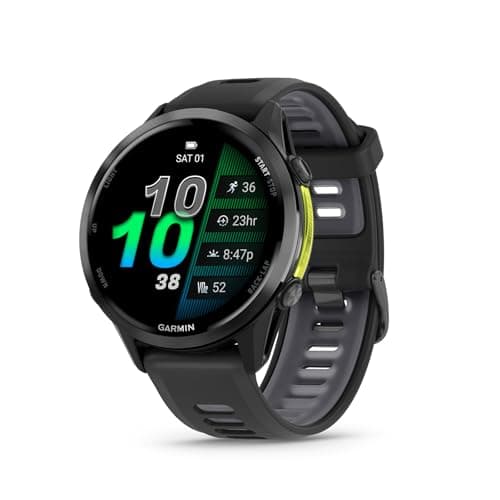
Built-in mapping, endurance score, hill score, running tolerance, realtime stamina, an LED flashlight, sapphire and titanium, 32 GB and up to 26 hours of GPS-only battery. The cons: 56 g, one case size that starts at a 135 mm wrist, and running economy needs an accessory sold separately.
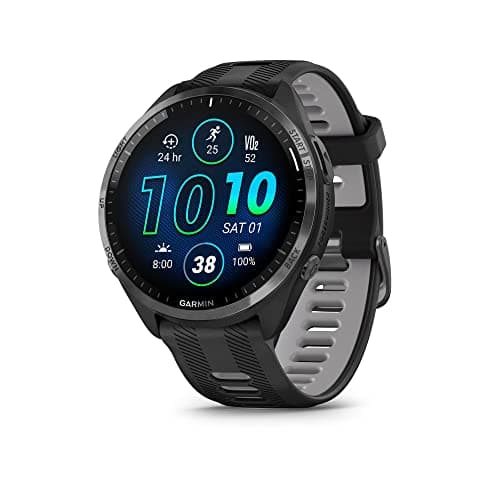
The previous flagship, still sold by Garmin: up to 31 hours GPS-only and up to 23 days as a smartwatch, with preloaded maps and 32 GB. The cons: no flashlight, no speaker or mic, no running tolerance, and the largest case here at 47.2 x 13.2 mm.
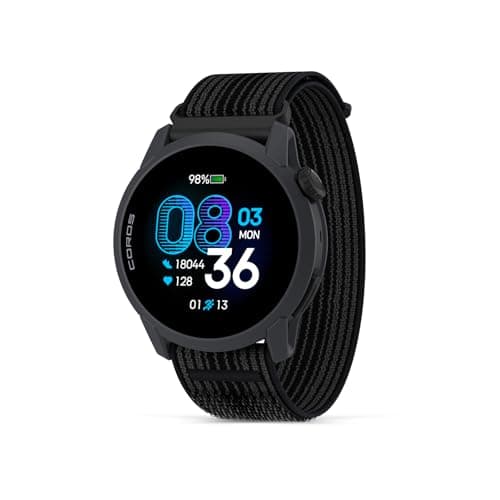
Up to 41 hours all-systems GPS, up to 31 hours dual-frequency, downloadable global maps, and 32 g on the nylon band. The cons: a mineral glass lens, no contactless payment on the spec list, and the always-on display cuts daily battery from 19 days to 6.
#ad · Price as of November 2, 2026 · Affiliate disclosure for the link to COROS Pace 4
The short answer
Garmin's premium Forerunner pair is unusually hard to separate, because almost everything a runner trains with is on both spec sheets. That is the first thing to understand, and it is the opposite of how these watches get sold: the 570 is not a cut-down 970 with features missing from the training side. It is the same training watch in a smaller, lighter body with a shorter battery and no maps.
So the question is not “which watch has the features.” It is whether four extra metrics, a map, a flashlight, an ECG app, a sapphire lens and eight more hours of GPS tracking are worth the price gap and 14 extra grams. For most runners training for a half or a full marathon, the answer is no — which is why the 570 is our pick here. For a specific kind of runner, mostly one who runs unfamiliar routes or trains over very long distances, the answer is yes.
What is identical
These rows appear on Garmin's spec tables for both the Forerunner 570 and the Forerunner 970, so nobody should pay the gap expecting any of them:
Training readiness and training status (Garmin marks both as “improved” and both list unified training status).
Lactate threshold, running power and recovery time — the three figures a structured training block actually runs on.
VO2 max for both road and trail running, plus PacePro pacing strategies for a goal-paced race.
Garmin triathlon coach and on-screen workout muscle maps.
Multi-band GPS with SatIQ, music storage, a built-in speaker and microphone, Garmin Pay, Wi-Fi and a 5 ATM water rating.
An AMOLED touchscreen with an optional always-on mode, and a barometric altimeter.
That list is the whole engine of a marathon build. If you came here wondering whether the cheaper watch can run Garmin's coaching plans and give you readiness and power, it can.
What the 970 actually adds
Here is the complete set of rows the 970 lists and the 570 does not:
A long-horizon read on your ability to sustain prolonged effort
Hill score
Not listed
A measure of hill-running capability
Running tolerance
Not listed
How much running load your body is currently absorbing
Realtime stamina
Not listed
A live estimate of how much you have left, mid-race
Running economy (with a compatible accessory)
Not listed
Energy efficiency — and Garmin's own table says it needs extra hardware
Garmin ECG app
Not listed
A heart-rhythm recording feature, not a training tool
LED flashlight
Not listed
Dark early starts, and genuinely more useful than it sounds
Sapphire crystal lens, titanium bezel
Gorilla Glass 3, aluminum
Scratch resistance
32 GB memory
8 GB
Maps and music, mostly maps
Up to 26 hours GPS-only; up to 15 days smartwatch
Up to 18 hours; up to 10-11 days
Time between charges
Two notes on that table that matter more than they look. First, running economy is listed by Garmin as “yes (with compatible accessory)” — so it is not a feature you get out of the box on the 970 either. Second, the ECG app is a health feature rather than a running one, and it should not be in a decision about which running watch to buy.
Size and weight: 42 g vs 56 g
This is the row that should decide it for more people than it does. The 570 comes in two cases; the 970 comes in one.
Model
Case
Fits wrists
Weight
Display
Forerunner 570, 42 mm
42.4 x 42.4 x 12.9 mm
115-178 mm
42 g
1.2 in (30.4 mm), 390 x 390
Forerunner 570, 47 mm
47 x 47 x 12.9 mm
135-205 mm
50 g
1.4 in (35.3 mm)
Forerunner 970
47 x 47 x 12.9 mm
135-205 mm
56 g
1.4 in (35.3 mm)
Garmin fits the 42 mm Forerunner 570 to wrists from 115 mm. The 970 starts at 135 mm. If your wrist is under 135 mm around, the comparison on this page has already ended: the 570 in 42 mm is the watch, and no feature list changes that. A watch that slides around is a watch with a worse optical heart rate reading, which undermines every metric either model computes.
At the other end, the 970 is 56 g against the 42 mm 570's 42 g — a third more weight, in the same 12.9 mm thickness. On a 20-mile long run that is noticeable, and it is one of the few differences here you feel rather than read.
Battery, and the awkward 965 problem
The 970 wins the straight fight: up to 26 hours of GPS-only tracking and up to 15 days as a smartwatch, against the 570's 18 hours and 10 days (11 on the 47 mm). For a marathon that is not a decider — the longest sensible long run is four hours and nobody is charging mid-block — but for a runner who forgets to charge things, eight extra hours of headroom is real.
Here is the awkward part. Garmin still sells the Forerunner 965, the previous flagship, and its spec sheet lists up to 31 hours GPS-only and up to 23 days as a smartwatch — more than the 970 on both, with preloaded road and trail maps and the same 32 GB. What the 965 gives up is the newest metrics (no running tolerance, no realtime stamina), the LED flashlight and the speaker and microphone.
So the honest shape of this decision is a three-way, not a two-way: the 570 for weight and size, the 970 for the newest feature set, the 965 for battery and maps at less money. Our best GPS watch for marathon training page ranks the full field on exactly these figures.
Figures as published by the maker or the named reviewer; each value links to its source. A dash means the figure isn't in our cited sources.
Every row above is from Garmin's own published spec tables, checked on its product pages. We do not test watches and we do not reprint battery figures from third-party testing: Garmin's numbers are the maker's claims, and real-world GPS battery depends on the GNSS mode, the display setting and whether you are playing music.
Are the four extra metrics worth it?
Endurance score, hill score, running tolerance and realtime stamina are the 970's real pitch, so they deserve an honest look rather than a feature-count.
Realtime stamina is the most defensible of the four for a racer. Garmin describes it as data to help guide you toward your best possible performance, and the use case — not blowing up at 18 miles — is a genuine one.
Running tolerance tells you how much running load your body is absorbing. If you are already reading training readiness and recovery time on either watch, this is a finer-grained version of a thing you can already see.
Hill score matters if you train and race on hills, and is close to noise if you run flat roads.
Endurance score is a long-horizon trend number. It is interesting. It is not something you act on in a given week.
The pattern: one of the four changes race-day decisions, one refines something you already have, and two are mostly data. If maps are not a reason for you, these four alone are a thin case for the upgrade — and the map is the feature on the 970 that most clearly does something the 570 cannot.
Level by level
This site picks gear by pace and weekly mileage, so here is the honest sort.
Half marathon. The Forerunner 570, in whichever case fits. Hal Higdon's Novice 1 Half runs 12 weeks to a 10-mile long run, and training readiness, lactate threshold and PacePro — all on the 570 — cover every decision in it.
Marathon. Still the 570 for most people. Higdon's Novice 1 Marathon is 18 weeks to a 20-mile long run; the 570's 18 hours of GPS-only battery covers a four-hour long run four times over. Move to the 970 if you run unfamiliar long routes and want the map, or if realtime stamina on race day is worth the gap to you. Pair either with the rotation in our marathon training mileage and shoe rotation guide.
Trail or ultra-distance. This is where the 970 stops being a luxury: maps, hill score and the longer battery all point the same way. Both watches list VO2 max for trail running.
The two watches to buy instead
Garmin Forerunner 965. The previous flagship, still sold: up to 31 hours GPS-only, up to 23 days smartwatch, preloaded maps, 32 GB, titanium bezel. No flashlight, no speaker or mic, none of the newest metrics, and the biggest case here at 47.2 x 13.2 mm.
COROS Pace 4. If battery and weight are the only things you care about, this is the outlier: COROS lists up to 41 hours with all systems on, up to 31 hours in all-systems dual-frequency, and 32 g on the nylon band, with downloadable global maps. The trade is a mineral glass lens, no contactless payment on the spec list, and no Garmin coaching ecosystem — see Garmin vs COROS for the whole argument.
Buy the Forerunner 570 if: your wrist is under 135 mm and you need the 42 mm case; you want the lighter watch at 42 g; you train for road halves and marathons and will use training readiness, lactate threshold, running power and PacePro — all of which it has; or you simply do not want to pay for a map you will not open.
Buy the Forerunner 970 if: you run unfamiliar routes and want on-watch maps; you want realtime stamina for race-day pacing decisions; you train on hills or on trail and want hill score and the longer battery; or you want the sapphire lens and titanium bezel and know that is what you are paying for.
In detail
The contenders, in full
The one most runners should buy
Garmin Forerunner 570
C25K10KHALFMARATHON
8.5 /10
Every core running feature the 970 has, in a 42 mm case Garmin fits to wrists from 115 mm, at 42 g. The cons: no maps on its spec sheet, up to 18 hours of GPS-only battery (the shortest premium Garmin here), and no endurance score, hill score or running tolerance.
#ad · Price as of November 2, 2026 · Affiliate disclosure for the link to Garmin Forerunner 570
Buy this for maps or for the long-distance metrics
Garmin Forerunner 970
C25K10KHALFMARATHON
9.0 /10
Built-in mapping, endurance score, hill score, running tolerance, realtime stamina, an LED flashlight, sapphire and titanium, 32 GB and up to 26 hours of GPS-only battery. The cons: 56 g, one case size that starts at a 135 mm wrist, and running economy needs an accessory sold separately.
#ad · Price as of November 2, 2026 · Affiliate disclosure for the link to Garmin Forerunner 970
If battery and maps are the whole reason
Garmin Forerunner 965
C25K10KHALFMARATHON
8.7 /10
The previous flagship, still sold by Garmin: up to 31 hours GPS-only and up to 23 days as a smartwatch, with preloaded maps and 32 GB. The cons: no flashlight, no speaker or mic, no running tolerance, and the largest case here at 47.2 x 13.2 mm.
#ad · Price as of November 2, 2026 · Affiliate disclosure for the link to Garmin Forerunner 965
If you only care about battery and weight
COROS Pace 4
C25K10KHALFMARATHON
8.7 /10
Up to 41 hours all-systems GPS, up to 31 hours dual-frequency, downloadable global maps, and 32 g on the nylon band. The cons: a mineral glass lens, no contactless payment on the spec list, and the always-on display cuts daily battery from 19 days to 6.
#ad · Price as of November 2, 2026 · Affiliate disclosure for the link to COROS Pace 4
How we chose these
Researched, compared, scored for your level
We start from what a published training plan actually asks of a runner at your level, compare every model's published specs (stack height, drop, weight, plate, stability features, widths) against that job, and score each pick on a public rubric. Each spec links to where it came from, so you can shortlist in minutes and buy with the numbers in front of you.
What is the difference between the Garmin Forerunner 570 and 970?+
The core running features are the same: both list training readiness, improved training status, lactate threshold, running power, PacePro, VO2 max for road and trail, multi-band GPS, music and a speaker and microphone. The 970 adds built-in maps, endurance score, hill score, running tolerance, realtime stamina, an ECG app, an LED flashlight, a sapphire lens and titanium bezel, 32 GB instead of 8 GB, and up to 26 hours of GPS-only battery against 18.
Is the Forerunner 970 worth the extra money over the 570?+
For most road runners, no. The 570 carries every training metric a half or marathon build runs on. The 970 earns the gap if you want on-watch maps, if realtime stamina will change your race-day pacing, or if you train on hills and trail. If your reason is purely battery and maps, the older Forerunner 965 lists more of both than the 970 does.
Does the Forerunner 570 have maps?+
No. Built-in mapping and preloaded road, trail and ski resort maps appear on the Forerunner 970's spec sheet and not on the 570's. The 570 does list PacePro pacing strategies and multi-band GPS, so it records and paces accurately — it just will not draw you a map.
Which has better battery life?+
The 970: up to 26 hours of GPS-only tracking and up to 15 days in smartwatch mode, against the 570's up to 18 hours and up to 10 days (11 on the 47 mm). Both are Garmin's own claims and both fall with multi-band GNSS, an always-on display or music playback.
Which one fits a small wrist?+
The Forerunner 570 in 42 mm. Garmin fits it to wrists with a circumference of 115-178 mm and lists it at 42 g. The 970 comes in one 47 mm case, which Garmin fits to 135-205 mm. If your wrist is under 135 mm, the 570 is the only one of the two that fits properly, and fit affects the optical heart-rate reading every other metric depends on.
Does the Forerunner 970 measure running economy out of the box?+
No. Garmin's own spec table marks running economy as “yes (with compatible accessory),” so it needs hardware beyond the watch. It is not a reason on its own to choose the 970.
Should I buy the older Forerunner 965 instead?+
Consider it seriously if battery and maps are your reasons. Garmin lists the 965 at up to 31 hours GPS-only and up to 23 days as a smartwatch — more than either watch here — with preloaded road and trail maps, 32 GB and a titanium bezel. You give up the LED flashlight, the speaker and microphone, and the newest metrics including running tolerance and realtime stamina, and it is the largest case of the three at 47.2 x 13.2 mm.
Do both watches work with Garmin's coaching plans?+
Yes. Garmin lists Garmin triathlon coach, training readiness, unified training status, recovery time and PacePro on both the 570 and the 970, and both carry multi-band GPS with SatIQ. The coaching side of the Garmin ecosystem is not where these two watches differ.
Every figure above is traceable. Specs come from the maker's own pages or the named reviewer's published measurements (linked above); level definitions come from published training plans; prices come from Amazon's own API and carry the date they were checked, so you buy on a current number. Read the full method.