Best Massage Gun for Runners: Five Picks, Ranked on the Specs Makers Actually Publish
Amplitude and stall force are the two numbers that decide whether a massage gun reaches muscle. Therabody publishes one of them. Hyperice publishes neither. Five currently-sold devices ranked on what is actually printed, plus an honest account of what a 2023 systematic review found percussion does for runners.
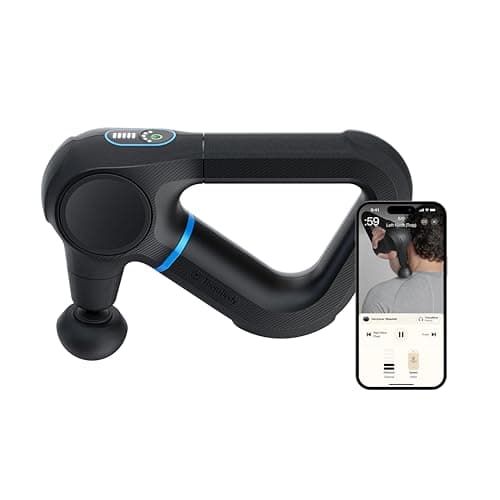
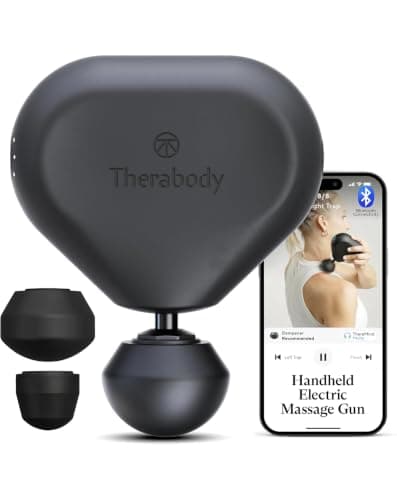
A published 10 mm amplitude at 0.45 kg, three speeds (1750, 2100 and 2400 PPM) and a travel lock. Cons: 10 mm is the shallowest stroke here, Therabody lists only around 120 minutes of battery, and three attachments is a short list for the price.
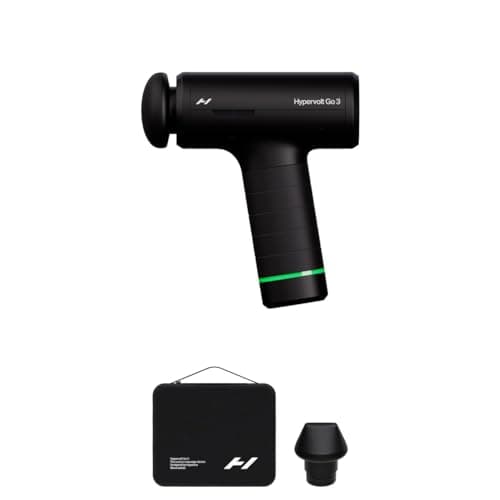
Five speeds across 1500-2500 RPM, up to four hours of battery and 1.6 pounds, at the lowest price on this page. Cons: Hyperice publishes no amplitude at all, there are only two broad attachments, and 55 dB is the loudest figure it prints.
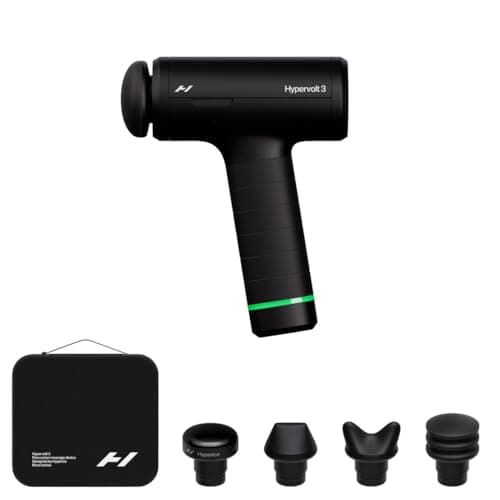
48 dB, up to four hours, five heads including a heated one, and a pressure sensor that shows how hard you are pressing. Cons: 2.0 pounds, still no published amplitude, and the heated head is a comfort feature nothing here measures.
The cheapest device here with a published 16 mm amplitude, plus on-device pressure feedback and five speeds. Cons: two attachments only at this price, around 120 minutes of battery, and 0.907 kg is twice the Mini.
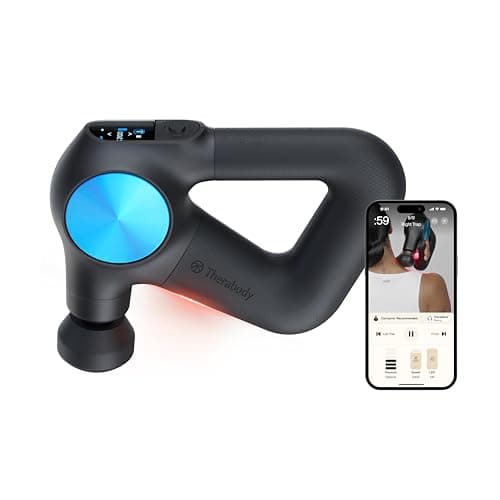
The same 16 mm amplitude as the Prime plus heat, vibration, five heads, an LCD screen and around 150 minutes of battery. Cons: 3.64 lbs, the highest price here by a wide margin, and the cold attachment is sold separately.
#ad · Prices come live from Amazon, last checked November 2, 2026. Scores are ours, compiled from published specs and the maker's intended use. Product photos come from Amazon. Tap a row for the full write-up.
Who this page is for
The best massage gun for most runners is the Therabody Theragun Mini (3rd Gen), and the reason is boring: it is the only pick here that combines a published amplitude figure with a weight you can hold against the back of your own leg for five minutes. Therabody lists 10 mm of percussive amplitude, 0.45 kg without attachments and three speeds of 1750, 2100 and 2400 PPM. Everything a runner uses one of these for — calves, quads, hamstrings, glutes — happens with your arm at an awkward angle, and the heavy devices lose that argument before the specs matter.
If the price is the obstacle, the Hyperice Hypervolt Go 3 is the cheapest device on this page from a brand that prints real numbers, with up to four hours of battery — roughly double what either Theragun lists. If you want the deepest published stroke, the Theragun Prime is the cheapest device here with a 16 mm amplitude. Those are the three decisions.
One thing to be clear about before you spend anything: a massage gun is a comfort and range-of-motion tool with modest evidence behind it, not a treatment and not a shortcut to fitness. The next section is the honest version of what the research found.
Flexibility and range of motion: a real short-term effect. The review reports massage guns “could be effective in improving iliopsoas, hamstrings, triceps suralis and the posterior chain muscles' flexibility” — which is, conveniently, almost exactly the list of places a runner gets tight.
Recovery after a hard session: supported, modestly. In recovery-related outcomes the review found massage guns to be “cost-effective instruments for stiffness reduction, range of motion and strength improvements after a fatigue protocol.”
Using one as a warm-up to run faster: do not. For strength, balance, acceleration, agility and explosive activity the review found the devices “either did not have improvements or … even showed a decrease in performance.” If you were planning to buzz your calves on the start line of a 5K, that is the sentence to read twice.
No change in some things people assume it changes. The review reports no differences in contraction time, rating of perceived exertion or lactate concentration.
And the caveat, which matters as much as the findings: the authors screened 281 records and could include only 11. Ten of those eleven carried a moderate risk of bias and one a high risk. This is a thin, early evidence base, and the authors say so themselves — they call for “further high-quality studies” because “there are still uncertainties about the physiological effects of these instruments.” Any page that tells you a massage gun is proven to prevent injury or speed up healing is going further than the literature does.
What we ranked on
We do not test gear. Every figure on this page is the maker's own published specification, linked on the spec that uses it, and availability was checked on each maker's store before anything was featured. Five criteria, in this order:
Published amplitude. How far the head travels on each stroke, and the single spec that separates a device that reaches muscle from one that buzzes skin. Therabody prints it for every current Theragun. Hyperice prints it for none.
Weight. You hold this one-handed, often reaching behind your own leg. The field here runs from 0.45 kg to 1.65 kg — a factor of nearly four.
Battery and charging. Hyperice lists up to four hours; Therabody lists around two to two and a half. A device that needs charging before every use gets used less.
Noise. The only published dB figures here come from Hyperice (48 dB and 55 dB). It sounds like a trivial spec until you own one and live with someone.
Attachments you will actually use. A broad head for quads and a narrower one for a calf knot covers almost everything. Seven heads is mostly a box-filling exercise.
Price is a filter rather than a criterion, and it is a big spread: the most expensive pick here lists for several times the cheapest. Check the current price on each card. We do not print numbers in the prose that go stale a week after publication.
What we deliberately did not rank on is stall force — the pressure a device absorbs before the motor bogs down. It is genuinely useful, review sites quote it constantly, and neither Therabody nor Hyperice publishes it for any current model. The numbers in circulation come from older generations or from third parties, so they are not on this page.
Amplitude: the spec that matters most
Amplitude is the stroke length — how deep into the tissue each percussion travels. It is the difference between a device that moves a quad and one that tickles it, and it is the reason two guns with identical speed ranges can feel nothing alike.
Device
Published amplitude
Weight (without attachments)
Battery (published)
Theragun Mini (3rd Gen)
10 mm
0.45 kg (0.99 lbs)
Around 120 min
Hypervolt Go 3
Not published
1.6 lbs
Up to 4 hours
Hypervolt 3
Not published
2.0 lbs
Up to 4 hours
Theragun Prime
16 mm
0.907 kg (1.99 lbs)
Around 120 min
Theragun PRO Plus
16 mm
1.65 kg (3.64 lbs)
Around 150 min
Two things fall out of that table. First, the step from 10 mm to 16 mm is the only genuine jump in reach available, and it costs you weight: the 16 mm Prime is twice the Mini, and the 16 mm PRO Plus is nearly four times it. Second, the two Hypervolts simply do not let you make this comparison. Hyperice publishes RPM, weight, battery and a decibel figure, which is more than many brands, but not the one number that tells you how deep the stroke goes.
That gap is why the Mini wins this page rather than the Prime. Sixteen millimeters is more reach than ten, and for a runner working a calf or a hamstring, ten is enough — while the thing that decides whether you finish the session is whether your arm gets tired first.
Weight: you are holding this one-handed
Foam rollers use your bodyweight. Massage guns use your arm, and the geometry is unkind: to reach your own hamstring or the outside of your own glute you end up pressing with a bent wrist at an angle you would never choose. That is why weight belongs this high in the ranking, and why the field's spread matters.
Under a pound (Theragun Mini, 0.45 kg). Holdable for as long as you want, fits in a race bag, and Therabody gives it a travel lock so it does not switch itself on in your luggage.
1.6 to 2.0 pounds (Hypervolt Go 3, Hypervolt 3). Fine for quads and calves seated. You will notice it reaching across your back.
0.907 kg (Theragun Prime). Heavier than the Hypervolt Go 3, but the Theragun handle shape genuinely helps: the triangular grip gives you three ways to hold it, which is the part spec sheets never capture.
1.65 kg (Theragun PRO Plus). A two-handed device for anything behind you. If you intend to use it on yourself rather than on someone else, this is the pick to think hardest about.
Speed, time and the numbers clinicians use
Speed is quoted two different ways and it confuses everyone. Hyperice publishes RPM (1500-2500 for both Hypervolts). Therabody publishes PPM (1750, 2100 and 2400 on the Mini). They are the same unit: percussions per minute. Divide by 60 to get hertz, which is what the research uses.
Ferreira and colleagues note that commercial massage guns span roughly 17 to 53 Hz, and that in a survey clinicians most often reported using 17 to 40 Hz, a treatment time of 30 to 180 seconds and a cadence of 2 to 10 seconds. Run the conversions on this page's picks and something useful appears:
Published speed
In hertz
Inside the 17-40 Hz clinician range?
Theragun Mini: 1750 PPM
~29 Hz
Yes
Theragun Mini: 2100 PPM
35 Hz
Yes
Theragun Mini: 2400 PPM
40 Hz
At the top of it
Hypervolt: 1500 RPM (lowest)
25 Hz
Yes
Hypervolt: 2500 RPM (highest)
~42 Hz
Just above it
The practical conclusion: every device here has usable settings, and the highest setting is not the useful one. A three-speed device whose speeds all land in the band clinicians actually use is not worse than a five-speed device with two settings nobody recommends. Treat 30 to 180 seconds per muscle as the dose and stop there; nothing in the literature rewards ten minutes on one calf.
Roller or massage gun?
If you own neither, buy a foam roller first. It is a fraction of the price, it treats a whole muscle at once with your bodyweight instead of your arm, and the evidence base behind it is slightly better developed — the 2019 meta-analysis on foam rolling found a +6.0% effect on post-exercise muscle soreness (g = 0.47), the single clearest recovery number in either category. Our best foam roller for runners page ranks that field.
A massage gun earns its place for the jobs a roller is bad at. One reliable knot in one calf. The soleus, low and deep, where a roller just presses the whole lower leg. Your own glute, which is awkward to load on a roller and easy to reach with a short device. Travel, where a 13-inch tube does not go in a carry-on and a 0.45 kg gun does. And the pre-run flexibility use, where the review above found the clearest short-term effect — as long as you are not expecting it to make you faster.
The honest summary is that they overlap more than the marketing suggests, and if you have a roller and use it, a gun is an addition rather than an upgrade.
What to buy at each level
This site picks gear by pace and weekly mileage rather than by category, so here is the short version.
Couch to 5K. None of these. The NHS Couch to 5K plan is nine weeks of run/walk intervals three times a week, and new-runner soreness is your legs adapting rather than something percussion fixes. Spend the money on shoes — our Couch to 5K gear checklist puts the spend in order.
First 10K. Still a roller first. If you want a gun anyway, the Hypervolt Go 3 is the least money at stake while you find out whether you are a person who uses one.
Half marathon. The Theragun Mini. Long runs are where a single stubborn calf or soleus spot becomes a weekly feature, and that is the job this tool is genuinely better at than a roller.
Marathon.Hal Higdon's Novice 1 Marathon runs 18 weeks to a 20-mile long run. At that load the Mini still covers it; the Hypervolt 3 is the defensible upgrade if noise and battery are what bother you, and the Prime if you want the deeper 16 mm stroke. Pair any of them with the rotation in our marathon training mileage and shoe rotation guide, which is where most recovery problems are actually solved.
A published 10 mm amplitude at 0.45 kg, three speeds (1750, 2100 and 2400 PPM) and a travel lock. Cons: 10 mm is the shallowest stroke here, Therabody lists only around 120 minutes of battery, and three attachments is a short list for the price.
#ad · Price as of November 2, 2026 · Affiliate disclosure for the link to Therabody Theragun Mini (3rd Gen)
2
Cheapest sensible way in
Hyperice Hypervolt Go 3
C25K10KHALFMARATHON
8.1 /10
Five speeds across 1500-2500 RPM, up to four hours of battery and 1.6 pounds, at the lowest price on this page. Cons: Hyperice publishes no amplitude at all, there are only two broad attachments, and 55 dB is the loudest figure it prints.
#ad · Price as of November 2, 2026 · Affiliate disclosure for the link to Hyperice Hypervolt Go 3
3
Quietest, longest battery
Hyperice Hypervolt 3
C25K10KHALFMARATHON
8.2 /10
48 dB, up to four hours, five heads including a heated one, and a pressure sensor that shows how hard you are pressing. Cons: 2.0 pounds, still no published amplitude, and the heated head is a comfort feature nothing here measures.
#ad · Price as of November 2, 2026 · Affiliate disclosure for the link to Hyperice Hypervolt 3
4
Most reach per dollar
Therabody Theragun Prime
C25K10KHALFMARATHON
8.1 /10
The cheapest device here with a published 16 mm amplitude, plus on-device pressure feedback and five speeds. Cons: two attachments only at this price, around 120 minutes of battery, and 0.907 kg is twice the Mini.
+A published 16 mm amplitude, the deepest figure any maker on this page prints, at the lowest price that prints one
+On-device pressure feedback, so the intensity you apply is a number rather than a guess
+The Theragun handle shape genuinely does reach your own upper back and hamstrings
+Five speeds without the app, with more unlocked if you use it
What it doesn't
−Two attachments only, at a price well above the Hypervolt Go 3's
−Around 120 minutes of battery against the Hypervolt line's four hours
−0.907 kg is twice the Theragun Mini's weight and it does not fit a race bag the same way
−Therabody publishes no stall force for this or any current Theragun, so 'how hard can I press before it bogs down' is unanswered
Skip this if…
…you want something you can pack for a race weekend, or you are buying your first recovery tool at all; a foam roller does the broad work for a fraction of this
#ad · Price as of November 2, 2026 · Affiliate disclosure for the link to Therabody Theragun Prime
5
Only if heat is the point
Therabody Theragun PRO Plus
C25K10KHALFMARATHON
7.6 /10
The same 16 mm amplitude as the Prime plus heat, vibration, five heads, an LCD screen and around 150 minutes of battery. Cons: 3.64 lbs, the highest price here by a wide margin, and the cold attachment is sold separately.
#ad · Price as of November 2, 2026 · Affiliate disclosure for the link to Therabody Theragun PRO Plus
Common mistakes
Buying on speed. A high RPM number sells devices and tells you almost nothing. The top setting on most guns sits above the band clinicians report using, and amplitude is the spec that decides reach.
Trusting a stall-force number you found in a review. No current Theragun or Hypervolt publishes one. Figures in circulation are from older generations or from third-party testing nobody can reproduce.
Buying the biggest one you can afford. The heaviest pick here is nearly four times the lightest, and the weight is the main reason these end up in a drawer.
Using it as a warm-up to go faster. The 2023 review found no improvement, and in some cases a decrease, in strength, acceleration, agility and explosive performance.
Going over bone, joints or the spine. Stay on muscle. Both makers say this and it is the one instruction people ignore.
Treating ten minutes as better than two. The reported treatment window is 30 to 180 seconds per area. Longer is not a bonus.
Buying one before you own a foam roller. The roller is cheaper, does the broad work better and has the clearer soreness number behind it.
Looking after it
Charge it after use, not before you want it. Both Theraguns here list around two hours of runtime; a flat battery at the moment you reach for it is how these end up unused.
Use the travel lock. The Theragun Mini has one. A device that switches on inside a race bag arrives flat.
Wipe the heads, not the motor housing. Attachments take the sweat; the body is not something to run under a tap.
Keep it out of hot cars. Lithium-ion batteries lose capacity fast at high temperatures, and both brands ship these TSA-friendly precisely because the battery must travel in the cabin.
Register the warranty. Both Therabody models here carry a 1-year limited warranty, which is short for a motorized device — so the registration is worth the five minutes.
How we chose these
Researched, compared, scored for your level
We start from what a published training plan actually asks of a runner at your level, compare every model's published specs (stack height, drop, weight, plate, stability features, widths) against that job, and score each pick on a public rubric. Each spec links to where it came from, so you can shortlist in minutes and buy with the numbers in front of you.
The Therabody Theragun Mini (3rd Gen). Therabody publishes a 10 mm percussive amplitude, 0.45 kg without attachments and three speeds (1750, 2100 and 2400 PPM) that all land inside the 17-40 Hz range clinicians report using. For a runner reaching behind their own leg, holdable weight beats a deeper stroke you stop using after 90 seconds.
Do massage guns actually work?+
For short-term range of motion, flexibility and recovery after a hard session, modestly and with limited evidence. The 2023 systematic review in the Journal of Functional Morphology and Kinesiology concluded that massage guns “can help to improve short-term range of motion, flexibility and recovery-related outcomes, but their use in strength, balance, acceleration, agility and explosive activities is not recommended.” It could include only 11 of 281 screened studies, ten of which carried a moderate risk of bias.
Should I use a massage gun before or after a run?+
After, or on a rest day, if what you want is less stiffness and more range of motion. Not immediately before anything fast: the same review found percussion either did not improve or actively reduced strength, acceleration, agility and explosive performance. A short pre-run session for flexibility is defensible; a pre-race session to run faster is not.
What amplitude do I need in a massage gun?+
Ten millimeters is enough for a runner working calves, quads, hamstrings and glutes. Sixteen millimeters reaches deeper and is the most any device on this page publishes. The complication is that only Therabody prints an amplitude figure for its current models at all — Hyperice publishes RPM, weight, battery and decibels, but no amplitude for the current Hypervolt line.
What about stall force?+
Stall force — the pressure a device takes before the motor bogs down — is a genuinely useful spec, and neither Therabody nor Hyperice publishes it for any current model. Every number you see quoted comes from an older generation or from third-party testing, so we do not rank on it and we do not reprint it.
Is a massage gun better than a foam roller?+
Different tool, not a better one. A roller treats a whole muscle with your bodyweight and has the clearer recovery number behind it (+6.0% on post-exercise soreness, g = 0.47, in the 2019 foam-rolling meta-analysis). A gun is better for one specific knot, for the soleus, for your own glute and for travel. If you own neither, buy the roller first.
How long should I use a massage gun on one muscle?+
Thirty to 180 seconds. That is the treatment time clinicians most often reported in the survey cited by the 2023 review, alongside speeds of 17-40 Hz. There is nothing in the literature that rewards staying on one calf for ten minutes.
Can I use a massage gun on an injury?+
No. Nothing on this page treats an injury and none of it is medical advice. Keep the head off bone, joints, the spine and anywhere swollen, bruised, numb or sharply painful, and read Therabody's published precautions and contraindications. If it hurts while you run or the pain keeps returning, see a clinician rather than buying a device.
Are massage guns allowed in carry-on luggage?+
Hyperice states that all Hypervolt massage guns are TSA friendly for carry-on, and that they must travel in the cabin rather than checked baggage because of the lithium-ion battery. The same battery rule applies to the Theraguns. Check your airline's current policy before a race trip.
Every figure above is traceable. Specs come from the maker's own pages or the named reviewer's published measurements (linked above); level definitions come from published training plans; prices come from Amazon's own API and carry the date they were checked, so you buy on a current number. Read the full method.