Shoes · Guide
How to Break In New Running Shoes (Without Wrecking a Training Week)
ASICS puts break-in at two to four weeks, starting with short, slow, easy runs. Here is the week-by-week version, the one rotation trick that makes it painless, the three signs a shoe will never break in, and why the hairdryer trick is something even the brands tell you not to do.
We earn a commission if you buy through our links, at no extra cost to you. It never decides the ranking — the method is published · Affiliate disclosure
Why a new shoe needs breaking in at all
Mostly it is you adapting, not the shoe softening. ASICS makes exactly this point: even an identical replacement for a model you have worn for a year will have more responsive cushioning and a more rigid upper, so your body needs time to adjust. The foam compresses, the upper creases where your foot flexes, and your calves and feet settle into a slightly different loading pattern.
What is actually breaking in
- The upper. Mesh and overlays soften and crease at the flex point. This is the part people notice, and it happens fastest.
- The midsole. New foam is at its stiffest and bounciest. It settles over the first 30–50 miles, which is also why a shoe feels different in week three than on day one.
- You. The one that matters. If the new pair has a different heel-to-toe drop from your old pair, load shifts between your calf and Achilles and your knee — and RunRepeat's drop guide explains why dropping several millimeters needs a gradual transition rather than an immediate one. Our heel drop and stack height guide has the numbers.
The four-week plan
This follows ASICS' structure, spread across the four weeks it names. Compress it to two if the new pair is the same model as the old one; take all four if you are changing drop, brand or shoe type.
| Week | What to do in the new shoes | What to keep in the old shoes |
|---|---|---|
| Before week 1 | Wear them around the house for an hour or two. Check for pressure points while standing still. | Everything |
| Week 1 | One or two easy runs of 10–15 minutes, which ASICS suggests can be on a treadmill | Long run, any faster session |
| Week 2 | Two easy runs of 20–30 minutes | Long run, any faster session |
| Week 3 | Most easy runs, plus one steadier run | The long run |
| Week 4 | Everything, including the long run | Retire or demote the old pair |
If anything hurts — as opposed to feeling unfamiliar — go back a week. A hot spot on the arch in week one is information, not something to push through.
The rotation trick
This is the single most useful thing on the page, and it is ASICS' own advice: "For longer, tougher runs, use the old pair... For shorter and easier runs, use the new pair." Two consequences:
- Your training never pauses for a shoe purchase. The hard sessions stay in a shoe your body already knows.
- Buy the replacement before the old pair is dead. The AAOS puts a running shoe's useful life at roughly 500 miles, so buy at about 400 and overlap the two for a month. If you wait until the old pair is finished, you are forced to break in a new shoe with no fallback — which is how people end up doing a 16-mile long run in shoes with 12 miles on them.
Our running shoe rotation guide covers the longer-term version of this, and when to replace running shoes covers the signs it is time.
What to wear while you do it
Break-in is when blisters happen, because a new upper has not yet creased where your foot moves. ASICS is explicit that it is "especially important" to run in proper running socks during break-in — polyester and nylon blends that wick sweat, which reduces the moisture build-up and rubbing that cause blisters. Cotton socks hold water against your skin and are the single most common avoidable cause.
The three things worth having
Not a shoe list — you have just bought the shoe. These are the three items that make the four weeks above go smoothly, chosen on the blister features their makers publish.
Picks for this job
Three things that make break-in painless
Chosen on published fiber content and blister features, not on feel.
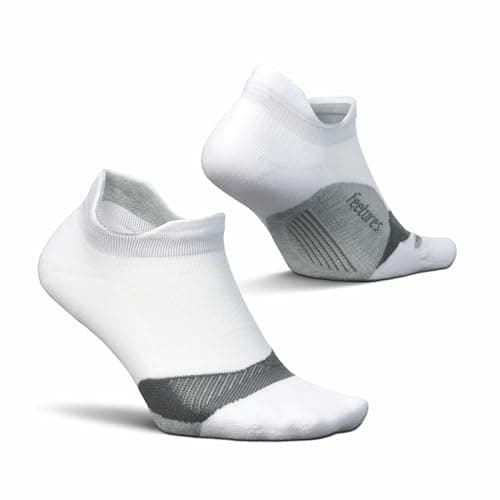
All levels: the all-round no-show
Feetures Elite Light Cushion No Show Tab
The default: 96% nylon and 4% spandex, right/left-specific shaping, a seamless toe and a double-thick heel 'Blister Tab' where new shoes rub most.
$19.00Amazon#ad · Price as of October 11, 2026 · Affiliate disclosure for the link to Feetures Elite Light Cushion No Show Tab
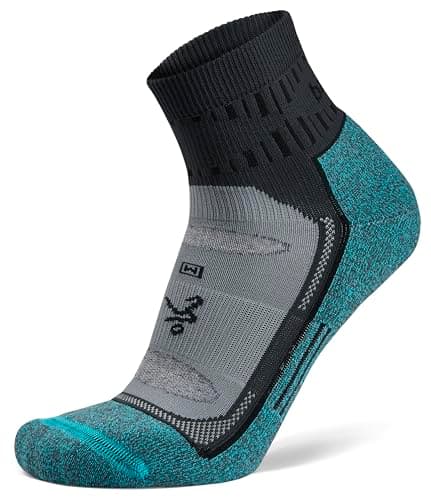
Blister-prone runners, any level
Balega Blister Resist Quarter
The pick if you are already blister-prone: a mohair-and-merino blend Balega describes as friction-reducing, with a seamless toe and an extra-deep heel pocket.
$20.99Amazon#ad · Price as of October 11, 2026 · Affiliate disclosure for the link to Balega Blister Resist Quarter
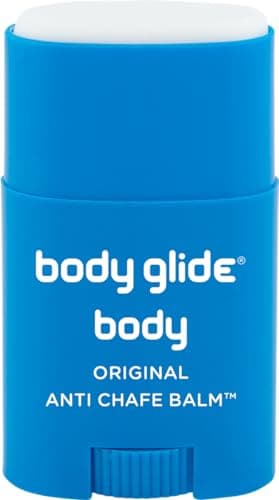
Every runner's kit; stocking stuffer
Body Glide Original Anti-Chafe Balm
For a known hot spot while the upper softens. A dry, invisible barrier the maker lists as sweat and water resistant and footwear safe.
$8.99Amazon#ad · Price as of October 11, 2026 · Affiliate disclosure for the link to Body Glide Original Anti-Chafe Balm
The full sock ranking is best running socks, and how to prevent blisters when running covers the problem properly.
Three signs a shoe will never break in
Break-in softens an upper. It does not change the shape or length of a shoe. Return it if any of these is true after the first short run:
- Your toes are cramped or pinched. Running Warehouse lists that as the sign of a shoe that is too small, and the AAOS asks for about half an inch beyond your longest toe. A shoe that is too short stays too short.
- Your heel slips. Try a heel-lock lacing pattern first — our narrow-feet guide explains how to tie it. If slip survives that, the shoe is too long or too wide.
- It pinches across the ball of the foot. That is a width problem, and the fix is a Wide or Extra Wide, not time. See best running shoes for wide feet. The ASICS fit guide is clear that lacing should hold your foot rather than compress it, so cranking the laces is not a solution.
What not to do
- Do not use the hairdryer or ice trick. ASICS lists both as emergency-only methods and says it would not usually recommend them, because its shoes are built with glues, plastics and rubber not designed to be exposed to high temperatures. Heating a midsole can change it permanently, and not for the better.
- Do not break in a shoe during race week. New shoes on race day is the oldest mistake there is — see our marathon race week checklist.
- Do not break in a shoe on the long run. The 20-mile long run in Higdon's Novice 1 Marathon is the worst possible place to discover a rub point.
- Do not change two things at once. A new shoe and a mileage increase in the same week means you cannot tell which caused the ache. The NHS Couch to 5K plan is already a progressive load; do not stack another change on top of it.
- Do not wear them for the first time without socks you have run in before. Two new variables, one set of blisters.
How we chose these
Researched, compared, scored for your level
We start from what a published training plan actually asks of a runner at your level, compare every model's published specs (stack height, drop, weight, plate, stability features, widths) against that job, and score each pick on a public rubric. Each spec links to where it came from, so you can shortlist in minutes and buy with the numbers in front of you.
Scores are our editorial judgments from that documented research, and rankings are earned on the rubric alone — placement is never for sale. The rubric and weights are on the How We Pick page.
Questions
Frequently asked
How long does it take to break in new running shoes?
Should I run in new shoes straight away?
Can I speed up breaking in running shoes with a hairdryer?
How do I know if new running shoes just need breaking in or are the wrong size?
When should I buy my next pair of running shoes?
Keep going
Related reading
- When to replace running shoesBuy the next pair before this one dies
- Running shoe rotation guideThe long-term version of the overlap
- How to prevent blisters when runningThe main break-in risk
- What size running shoes should I get?If it is a fit problem, not a break-in one
- Best running socksWhat ASICS says to wear while you do it
Receipts
Sources
- ASICS — How to break in running shoes: the two-to-four-week figure, 10-15 minute starts, sock advice, heat and ice warnings (checked 2026-10-11)
- ASICS — How should your running shoes fit? (checked 2026-10-11)
- Running Warehouse — Shoe Fit Tips: signs a shoe is too small or too big (checked 2026-10-11)
- OrthoInfo (AAOS) — Athletic Shoes: toe room and the 500-mile figure (checked 2026-10-11)
- RunRepeat — Heel-to-toe drop guide: transitioning between drops (checked 2026-10-11)
- Feetures — Elite Light Cushion No Show Tab: fiber content and blister features (checked 2026-10-11)
- Balega — Blister Resist Quarter: fiber content and blister features (checked 2026-10-11)
- Body Glide — Original Anti-Chafe Balm product page (checked 2026-10-11)
- NHS — Get running with Couch to 5K (checked 2026-10-11)
- Hal Higdon — Novice 1 Marathon training program (checked 2026-10-11)
Every figure above is traceable. Specs come from the maker's own pages or the named reviewer's published measurements (linked above); level definitions come from published training plans; prices come from Amazon's own API and carry the date they were checked, so you buy on a current number. Read the full method.